hwtLib.handshaked package
This package is dedicated to components and utilites realated to interfaces which are using handshake synchronization (ready + valid signals).
Most of the components will work for any interface inheriting from hwt.hwIOs.std.HandshakeSync
Submodules
hwtLib.handshaked.builder module
- class hwtLib.handshaked.builder.HsBuilder(parent: HwModule, srcInterface: HwIO | HObjList, name: str | None = None, master_to_slave: bool = True)[source]
Bases:
AbstractStreamBuilderHelper class which simplifies building of large stream paths
- FifoAsyncCls
alias of
HsFifoAsync
- FifoCls
alias of
HandshakedFifo
- JoinExplicitCls = NotImplemented
- JoinFairCls
alias of
HsJoinFairShare
- JoinPrioritizedCls
alias of
HsJoinPrioritized
- RegCls
alias of
HandshakedReg
- SplitCopyCls
alias of
HsSplitCopy
- SplitFairCls
alias of
HsSplitFair
- SplitPrioritizedCls
alias of
HsSplitPrioritized
- SplitSelectCls
alias of
HsSplitSelect
- __annotations__ = {}
hwtLib.handshaked.cdc module
- class hwtLib.handshaked.cdc.HandshakeFSM(hdlName: str | None = None)[source]
Bases:
HwModule- HDL IO:
clk - of type hwt.hwIOs.std.HwIOClk with dtype=<HBits, 1bit> - SLAVE
rst - of type hwt.hwIOs.std.HwIORst with dtype=<HBits, 1bit> - SLAVE
ack - of type hwt.hwIOs.std.HwIOSignal with dtype=<HBits, 1bit> - SLAVE
vld - of type hwt.hwIOs.std.HwIOSignal with dtype=<HBits, 1bit> - SLAVE
rd - of type hwt.hwIOs.std.HwIOSignal with dtype=<HBits, 1bit> - MASTER
- __annotations__ = {}
- class hwtLib.handshaked.cdc.HandshakedCdc(hshwIO: Type[HwIORdVldSync], hdlName: str | None = None)[source]
Bases:
HandshakedCompBaseCDC (Clock Domain Crossing) for handshaked interface
- HDL params:
HWIO_CLS - default value <class ‘hwt.hwIOs.std.HwIODataRdVld’> of type type
DATA_WIDTH - default value 64 of type int
DATA_RESET_VAL - default value None of type None
IN_FREQ - default value 100000000 of type int
OUT_FREQ - default value 200000000 of type int
- HDL IO:
dataIn_clk - of type hwt.hwIOs.std.HwIOClk with dtype=<HBits, 1bit> - SLAVE
dataIn_rst_n - of type hwt.hwIOs.std.HwIORst_n with dtype=<HBits, 1bit, n> - SLAVE
dataOut_clk - of type hwt.hwIOs.std.HwIOClk with dtype=<HBits, 1bit> - SLAVE
dataOut_rst_n - of type hwt.hwIOs.std.HwIORst_n with dtype=<HBits, 1bit, n> - SLAVE
dataIn - of type hwt.hwIOs.std.HwIODataRdVld - SLAVE
dataOut - of type hwt.hwIOs.std.HwIODataRdVld - MASTER
- HDL components:
in_ack_pulse_gen - of type hwtLib.clocking.cdc.CdcPulseGen
out_en_pulse_gen - of type hwtLib.clocking.cdc.CdcPulseGen
tx_fsm - of type hwtLib.handshaked.cdc.HandshakeFSM
rx_fsm - of type hwtLib.handshaked.cdc.HandshakeFSM
- __annotations__ = {}
- create_data_reg(name_prefix, clk=None, rst=None)[source]
Create a registers for data signals with default values from
hwt.hwModule.HwModuleparameters and with specified clk/rst
- propagate_clk(m: CdcPulseGen, reverse=False)[source]
hwtLib.handshaked.compBase module
- class hwtLib.handshaked.compBase.HandshakedCompBase(hshwIO: Type[HwIORdVldSync], hdlName: str | None = None)[source]
Bases:
HwModuleAbstract class for components which has HwIODataRdVld interface as main
- __annotations__ = {}
hwtLib.handshaked.dataRdVldToAxi4Stream module
- class hwtLib.handshaked.dataRdVldToAxi4Stream.DataRdVldToAxi4Stream(hshwIO: Type[HwIORdVldSync], hdlName: str | None = None)[source]
Bases:
HandshakedCompBasePack raw input data from
hwt.hwIOs.std.HwIODataRdVldinterface into Axi4Stream frames according to an input timeout or max frame size specification- HDL params:
IN_TIMEOUT - default value 10 of type intnumber of clk ticks until the actual frame is closed with the last word when if there are not input data
MAX_FRAME_WORDS - default value None of type Nonemaximum number of words in frame
DATA_WIDTH - default value 64 of type int
- HDL IO:
clk - of type hwt.hwIOs.std.HwIOClk with dtype=<HBits, 1bit> - SLAVE
rst_n - of type hwt.hwIOs.std.HwIORst_n with dtype=<HBits, 1bit, n> - SLAVE
dataIn - of type hwt.hwIOs.std.HwIODataRdVld - SLAVE
dataOut - of type hwtLib.amba.axi4s.Axi4Stream - MASTER
- HDL components:
r - of type hwtLib.handshaked.reg.HandshakedReg
- __annotations__ = {}
hwtLib.handshaked.fifo module
- class hwtLib.handshaked.fifo.HandshakedFifo(hshwIO: Type[HwIORdVldSync], hdlName: str | None = None)[source]
Bases:
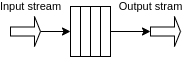
HandshakedCompBaseSynchronous FIFO for handshaked interfaces :note: 1clk to write, 1clk to load to output reg (and then 1clk to read next data).
- HDL params:
DEPTH - default value 2 of type int
EXPORT_SIZE - default value False of type bool
EXPORT_SPACE - default value False of type bool
INIT_DATA - default value () of type tuple
HWIO_CLS - default value <class ‘hwt.hwIOs.std.HwIODataRdVld’> of type type
DATA_WIDTH - default value 4 of type int
- HDL IO:
clk - of type hwt.hwIOs.std.HwIOClk with dtype=<HBits, 1bit> - SLAVE
rst_n - of type hwt.hwIOs.std.HwIORst_n with dtype=<HBits, 1bit, n> - SLAVE
dataIn - of type hwt.hwIOs.std.HwIODataRdVld - SLAVE
dataOut - of type hwt.hwIOs.std.HwIODataRdVld - MASTER
- HDL components:
r0 - of type hwtLib.handshaked.reg.HandshakedReg
r1 - of type hwtLib.handshaked.reg.HandshakedReg
- NON_DATA_BITS_CNT = 2
- REG_CLS
alias of
HandshakedReg
- __annotations__ = {}
- _connect_size_and_space(out_vld: HBitsRtlSignal | None, fifo: Fifo | None)[source]
- _connect_size_and_space_no_fifo()[source]
variant of
_connect_size_and_space()for the case that there is no fifo an registers are used instead
hwtLib.handshaked.fifoAsync module
- class hwtLib.handshaked.fifoAsync.HsFifoAsync(hshwIO: Type[HwIORdVldSync], hdlName: str | None = None)[source]
Bases:
HandshakedFifoAsynchronous FIFO using BRAM/LUT memory, based on:
- HDL params:
DEPTH - default value 5 of type int
EXPORT_SIZE - default value False of type bool
EXPORT_SPACE - default value False of type bool
INIT_DATA - default value () of type tuple
HWIO_CLS - default value <class ‘hwt.hwIOs.std.HwIODataRdVld’> of type type
DATA_WIDTH - default value 64 of type int
IN_FREQ - default value 100000000 of type int
OUT_FREQ - default value 100000000 of type int
- HDL IO:
dataIn_clk - of type hwt.hwIOs.std.HwIOClk with dtype=<HBits, 1bit> - SLAVE
dataOut_clk - of type hwt.hwIOs.std.HwIOClk with dtype=<HBits, 1bit> - SLAVE
dataIn_rst_n - of type hwt.hwIOs.std.HwIORst_n with dtype=<HBits, 1bit, n> - SLAVE
dataIn - of type hwt.hwIOs.std.HwIODataRdVld - SLAVE
dataOut_rst_n - of type hwt.hwIOs.std.HwIORst_n with dtype=<HBits, 1bit, n> - SLAVE
dataOut - of type hwt.hwIOs.std.HwIODataRdVld - MASTER
- HDL components:
fifo - of type hwtLib.mem.fifoAsync.FifoAsync
- __annotations__ = {}
hwtLib.handshaked.fifoDrop module
- class hwtLib.handshaked.fifoDrop.HandshakedFifoDrop(hshwIO: Type[HwIORdVldSync], hdlName: str | None = None)[source]
Bases:
HandshakedFifoFIFO for handsahaked interface which allows to discard/commit written data
- HDL params:
DEPTH - default value 8 of type int
EXPORT_SIZE - default value True of type bool
EXPORT_SPACE - default value True of type bool
INIT_DATA - default value () of type tuple
HWIO_CLS - default value <class ‘hwt.hwIOs.std.HwIODataRdVld’> of type type
DATA_WIDTH - default value 4 of type int
- HDL IO:
clk - of type hwt.hwIOs.std.HwIOClk with dtype=<HBits, 1bit> - SLAVE
rst_n - of type hwt.hwIOs.std.HwIORst_n with dtype=<HBits, 1bit, n> - SLAVE
dataIn - of type hwt.hwIOs.std.HwIODataRdVld - SLAVE
dataOut - of type hwt.hwIOs.std.HwIODataRdVld - MASTER
size - of type hwt.hwIOs.std.HwIOSignal with dtype=<HBits, 4bits, unsigned> - MASTER
space - of type hwt.hwIOs.std.HwIOSignal with dtype=<HBits, 4bits, unsigned> - MASTER
dataIn_discard - of type hwt.hwIOs.std.HwIOSignal with dtype=<HBits, 1bit> - SLAVE
dataIn_commit - of type hwt.hwIOs.std.HwIOSignal with dtype=<HBits, 1bit> - SLAVE
- HDL components:
fifo - of type hwtLib.mem.fifoDrop.FifoDrop
- __annotations__ = {}
hwtLib.handshaked.hwIOBiDirectional module
- class hwtLib.handshaked.hwIOBiDirectional.HwIORdVldSyncBiDirectionalData(masterDir=DIRECTION.OUT, hdlName: str | dict[str, str] | None = None, loadConfig=True)[source]
Bases:
HwIODataRdVldhwt.hwIOs.std.HwIODataRdVldinterface with datachannels in bout direction
- HDL params:
DATA_WIDTH - default value 64 of type int
- HDL IO:
din - of type hwt.hwIOs.std.HwIOSignal with dtype=<HBits, 64bits> - UNKNOWN (Master=IN)
dout - of type hwt.hwIOs.std.HwIOSignal with dtype=<HBits, 64bits> - UNKNOWN
vld - of type hwt.hwIOs.std.HwIOSignal with dtype=<HBits, 1bit> - UNKNOWN
rd - of type hwt.hwIOs.std.HwIOSignal with dtype=<HBits, 1bit> - UNKNOWN (Master=IN)
- __annotations__ = {}
- class hwtLib.handshaked.hwIOBiDirectional.HwIORdVldSyncBiDirectionalDataAgent(sim, hwIO)[source]
Bases:
HwIODataRdVldAgentSimulation agent for
HwIORdVldSyncBiDirectionalDatainterface- Attention:
for monitor number of items in dinData has to match with number of received items
- __annotations__ = {}
hwtLib.handshaked.joinFair module
Bases:
HsJoinPrioritizedJoin multiple input streams into single output stream. Priority is changing every clock period. If prioritized input is not sending valid data, input with lowest index and valid is used.
- Note:
combinational
Resolve isSelected signal flags for each input, when isSelected flag signal is 1 it means input has clearance to make transaction
Generate ack logic for selected input
- Parameters:
priorityReg – priority register with one hot encoding, 1 means input of this index should have be prioritized.
vldSignals – list of vld signals of input
index – index of input for which you wont get ack logic
- Returns:
ack signal for this input
hwtLib.handshaked.joinPrioritized module
- class hwtLib.handshaked.joinPrioritized.HsJoinPrioritized(hshwIO: Type[HwIORdVldSync], hdlName: str | None = None)[source]
Bases:
HandshakedCompBaseJoin input stream to single output stream inputs with lower number has higher priority
- HDL params:
INPUTS - default value 2 of type int
HWIO_CLS - default value <class ‘hwt.hwIOs.std.HwIODataRdVld’> of type type
DATA_WIDTH - default value 64 of type int
- HDL IO:
dataIn - of type hwt.hwIOs.hwIOArray.HwIOArray - SLAVE
dataOut - of type hwt.hwIOs.std.HwIODataRdVld - MASTER
- __annotations__ = {}
hwtLib.handshaked.ramAsAddrDataRdVld module
- class hwtLib.handshaked.ramAsAddrDataRdVld.HwIORamRdVldR(masterDir=DIRECTION.OUT, hdlName: str | dict[str, str] | None = None, loadConfig=True)[source]
Bases:
HwIOHwIODataRdVld RAM port
- HDL params:
ADDR_WIDTH - default value 8 of type int
DATA_WIDTH - default value 8 of type int
- HDL IO:
addr - of type hwt.hwIOs.std.HwIODataRdVld - UNKNOWN
data - of type hwt.hwIOs.std.HwIODataRdVld - UNKNOWN (Master=IN)
- __annotations__ = {}
- class hwtLib.handshaked.ramAsAddrDataRdVld.RamAsAddrDataRdVld(hdlName: str | None = None)[source]
Bases:
HwModuleConverter from a single ram port to handshaked interfaces
- HDL params:
ADDR_WIDTH - default value 32 of type int
DATA_WIDTH - default value 64 of type int
HAS_R - default value True of type bool
HAS_W - default value True of type bool
HAS_BE - default value False of type bool
- HDL IO:
clk - of type hwt.hwIOs.std.HwIOClk with dtype=<HBits, 1bit> - SLAVE
rst_n - of type hwt.hwIOs.std.HwIORst_n with dtype=<HBits, 1bit, n> - SLAVE
r - of type hwtLib.handshaked.ramAsAddrDataRdVld.HwIORamRdVldR - SLAVE
w - of type hwtLib.commonHwIO.addr_data.HwIOAddrDataRdVld - SLAVE
ram - of type hwt.hwIOs.std.HwIOBramPort_noClk - MASTER
- __annotations__ = {}
- read_logic(r: HwIORamRdVldR, ram: HwIOBramPort_noClk)[source]
hwtLib.handshaked.reg module
- class hwtLib.handshaked.reg.HandshakedReg(hshwIO: Type[HwIORdVldSync], hdlName: str | None = None)[source]
Bases:
HandshakedCompBaseRegister for HwIODataRdVld interfaces
- HDL params:
HWIO_CLS - default value <class ‘hwt.hwIOs.std.HwIODataRdVld’> of type type
DATA_WIDTH - default value 64 of type int
LATENCY - default value 1 of type int
DELAY - default value 0 of type int
INIT_DATA - default value () of type tuplea reset value of register (data is transferred from this register after reset) (an item for each stage of register, typically just 1 item) e.g. if register has latency=1 and interface has just data:uint8_t signal the INIT_DATA will be in format ((0,),)
- HDL IO:
clk - of type hwt.hwIOs.std.HwIOClk with dtype=<HBits, 1bit> - SLAVE
rst_n - of type hwt.hwIOs.std.HwIORst_n with dtype=<HBits, 1bit, n> - SLAVE
dataIn - of type hwt.hwIOs.std.HwIODataRdVld - SLAVE
dataOut - of type hwt.hwIOs.std.HwIODataRdVld - MASTER
- __annotations__ = {}
- _implLatencyAndDelay(inVld: RtlSignal, inRd: RtlSignal, inData: List[RtlSignal], outVld: RtlSignal, outRd: RtlSignal, prefix: str, initData: list, hasInit: bool)[source]
Create a register pipe
- See:
For param description see
HandshakedReg._impl_latency()
- _implReadyChainBreak(in_vld: RtlSignal, in_rd: RtlSignal, in_data: List[RtlSignal], out_vld: RtlSignal, out_rd: RtlSignal, prefix: str, initData: list, hasInit: bool)[source]
Two sets of registers 0. is prioritized 1. is used as a backup The in_rd is not combinationally connected to out_rd The out_vld is not combinationally connected to in_vld
- See:
For param description see
HandshakedReg._impl_latency()
- _implSkidBuff(inVld: RtlSignal, inRd: RtlSignal, inData: List[RtlSignal], outVld: RtlSignal, outRd: RtlSignal)[source]
latency 0-1, dealy 0, pass input directly to output and if output.ready=0, store data in internal buffer and wait until it is consumed before setting input.ready=1 again. Breaks ready chain but has combination path on “valid”.
- _impl_latency(inVld: RtlSignal, inRd: RtlSignal, inData: List[RtlSignal], outVld: RtlSignal, outRd: RtlSignal, prefix: str, initData: list, hasInit: bool)[source]
Create a normal handshaked register
- Parameters:
inVld – input valid signal (1 if producer is sending data)
inRd – input ready signal (send 1 if we are ready to receive the data)
inData – list of input data signals
outVld – output valid signal (1 if we are sending valid data)
outRd – output ready signal (1 if consummer is ready to receive the data)
prefix – name prefix used for internal signals
initData – list of init data for each data signal on iterface
hwtLib.handshaked.resizer module
- class hwtLib.handshaked.resizer.HsResizer(hshwIO: HwIORdVldSync, scale, inHwIOConfigFn, outHwIOConfigFn)[source]
Bases:
HandshakedCompBaseResize width of handshaked interface
- HDL IO:
clk - of type hwt.hwIOs.std.HwIOClk with dtype=<HBits, 1bit> - SLAVE
rst_n - of type hwt.hwIOs.std.HwIORst_n with dtype=<HBits, 1bit, n> - SLAVE
dataIn - of type hwt.hwIOs.std.HwIODataRdVld - SLAVE
dataOut - of type hwt.hwIOs.std.HwIODataRdVld - MASTER
- __annotations__ = {}
- __init__(hshwIO: HwIORdVldSync, scale, inHwIOConfigFn, outHwIOConfigFn)[source]
- Parameters:
hshwIO – class of interface which should be used as interface of this unit
scale – tuple (in scale, out scale) one of scales has to be 1, f. e. (1,2) means output will be 2x wider
inHwIOConfigFn – function inHwIOConfigFn(input interface) which will be applied on dataIn
outHwIOConfigFn – function outHwIOConfigFn(input interface) which will be applied on dataOut
hwtLib.handshaked.splitCopy module
- class hwtLib.handshaked.splitCopy.HsSplitCopy(hshwIO: Type[HwIORdVldSync], hdlName: str | None = None)[source]
Bases:
HandshakedCompBaseClone input stream to n identical output streams transaction is made in all interfaces or none of them

- HDL params:
OUTPUTS - default value 2 of type int
HWIO_CLS - default value <class ‘hwt.hwIOs.std.HwIODataRdVld’> of type type
DATA_WIDTH - default value 64 of type int
- HDL IO:
dataIn - of type hwt.hwIOs.std.HwIODataRdVld - SLAVE
dataOut - of type hwt.hwIOs.hwIOArray.HwIOArray - MASTER
- __annotations__ = {}
hwtLib.handshaked.splitFair module
- class hwtLib.handshaked.splitFair.HsSplitFair(hshwIO: Type[HwIORdVldSync], hdlName: str | None = None)[source]
Bases:
HsSplitCopySplit input stream to outputs, select single output for every input data based on priority.
Priority is changing every clock If prioritized output is not ready, input with lowest index and ready is used

- Variables:
~.selectedOneHot – handshaked interface with one hot encoded index of selected output
- HDL params:
OUTPUTS - default value 2 of type int
HWIO_CLS - default value <class ‘hwt.hwIOs.std.HwIODataRdVld’> of type type
DATA_WIDTH - default value 64 of type int
EXPORT_SELECTED - default value True of type bool
- HDL IO:
dataIn - of type hwt.hwIOs.std.HwIODataRdVld - SLAVE
dataOut - of type hwt.hwIOs.hwIOArray.HwIOArray - MASTER
clk - of type hwt.hwIOs.std.HwIOClk with dtype=<HBits, 1bit> - SLAVE
rst_n - of type hwt.hwIOs.std.HwIORst_n with dtype=<HBits, 1bit, n> - SLAVE
selectedOneHot - of type hwt.hwIOs.std.HwIODataRdVld - MASTER
- __annotations__ = {}
hwtLib.handshaked.splitPrioritized module
- class hwtLib.handshaked.splitPrioritized.HsSplitPrioritized(hshwIO: Type[HwIORdVldSync], hdlName: str | None = None)[source]
Bases:
HsSplitCopySplit input stream to N output streams. Data is send to output interface which is ready and has lowest index.

- HDL params:
OUTPUTS - default value 4 of type int
HWIO_CLS - default value <class ‘hwt.hwIOs.std.HwIODataRdVld’> of type type
DATA_WIDTH - default value 64 of type int
- HDL IO:
dataIn - of type hwt.hwIOs.std.HwIODataRdVld - SLAVE
dataOut - of type hwt.hwIOs.hwIOArray.HwIOArray - MASTER
- __annotations__ = {}
hwtLib.handshaked.splitSelect module
- class hwtLib.handshaked.splitSelect.HsSplitSelect(hshwIO: Type[HwIORdVldSync], hdlName: str | None = None)[source]
Bases:
HandshakedCompBaseSplit data from input interface to N output interfaces based on explicit output index provided by select interface.

- HDL params:
OUTPUTS - default value 3 of type int
HWIO_CLS - default value <class ‘hwt.hwIOs.std.HwIODataRdVld’> of type type
DATA_WIDTH - default value 64 of type int
- HDL IO:
clk - of type hwt.hwIOs.std.HwIOClk with dtype=<HBits, 1bit> - SLAVE
rst_n - of type hwt.hwIOs.std.HwIORst_n with dtype=<HBits, 1bit, n> - SLAVE
selectOneHot - of type hwt.hwIOs.std.HwIODataRdVld - SLAVE
dataIn - of type hwt.hwIOs.std.HwIODataRdVld - SLAVE
dataOut - of type hwt.hwIOs.hwIOArray.HwIOArray - MASTER
- HDL components:
selReg - of type hwtLib.handshaked.reg.HandshakedReg
- __annotations__ = {}
hwtLib.handshaked.storedBurst module
- class hwtLib.handshaked.storedBurst.HandshakedStoredBurst(hwIOCls=<class 'hwt.hwIOs.std.HwIODataRdVld'>, hdlName: str | None = None)[source]
Bases:
HwModuleThis units send data stored in property DATA over axi-stream interface
- HDL params:
DATA_WIDTH - default value 64 of type int
HWIO_CLS - default value <class ‘hwt.hwIOs.std.HwIODataRdVld’> of type type
REPEAT - default value False of type bool
DATA - default value (72, 101, 108, 108, 111, 32, 119, 111, 114, 108, 100) of type tuple
- HDL IO:
clk - of type hwt.hwIOs.std.HwIOClk with dtype=<HBits, 1bit> - SLAVE
rst_n - of type hwt.hwIOs.std.HwIORst_n with dtype=<HBits, 1bit, n> - SLAVE
dataOut - of type hwt.hwIOs.std.HwIODataRdVld - MASTER
- __annotations__ = {}
hwtLib.handshaked.streamNode module
- class hwtLib.handshaked.streamNode.ExclusiveStreamGroups(iterable=(), /)[source]
Bases:
listlist of tuples (cond, StreamNode instance) Only one stream from this group can be activated at the time
- ack() RtlSignal[source]
- Returns:
expression which’s value is high when transaction can be made over at least on child streaming node
- sync(enSig=None) List[HdlAssignmentContainer][source]
Create synchronization logic between streams (generate valid/ready synchronization logic for interfaces)
- Parameters:
enSig – optional signal to enable this group of nodes
- Returns:
list of assignments which are responsible for synchronization of streams
- class hwtLib.handshaked.streamNode.StreamNode(masters: List[HwIO | Tuple[RtlSignal | int, RtlSignal | int]] | None = None, slaves: List[HwIO | Tuple[RtlSignal | int, RtlSignal | int]] | None = None, extraConds: Dict[HwIO | Tuple[RtlSignal | int, RtlSignal | int], RtlSignal] | None = None, skipWhen: Dict[HwIO | Tuple[RtlSignal | int, RtlSignal | int], RtlSignal] | None = None)[source]
Bases:
objectGroup of stream master and slave interfaces to synchronize them to each other
- Variables:
~.masters – list of unique interfaces which are inputs into this node
~.slaves – list of unique interfaces which are outputs of this node
~.extraConds – dict {interface : extraConditionSignal} where extra conditions will be added to expression for channel enable. For master it means it will obtain ready=1 only if extraConditionSignal is 1. For slave it means it will obtain valid=1 only if extraConditionSignal is 1. All interfaces have to wait on each other so if an extraCond!=1 it causes blocking on all interfaces if not overridden by skipWhen.
~.skipWhen – dict {interface : skipSignal} where if skipSignal is high, the interface is disconnected from stream sync node and others does not have to wait for it (master does not need to have valid and slave ready)
- Note:
instead of interface it is possible to use tuple (valid, ready) signal, this tuple can also be (1, 1) but can only in masters or only in slaves
- Attention:
skipWhen has higher priority than extraCond
- __init__(masters: List[HwIO | Tuple[RtlSignal | int, RtlSignal | int]] | None = None, slaves: List[HwIO | Tuple[RtlSignal | int, RtlSignal | int]] | None = None, extraConds: Dict[HwIO | Tuple[RtlSignal | int, RtlSignal | int], RtlSignal] | None = None, skipWhen: Dict[HwIO | Tuple[RtlSignal | int, RtlSignal | int], RtlSignal] | None = None)[source]
- __repr__format_HwIO_list(hwIO_list)
- ack() RtlSignal[source]
- Returns:
expression which’s value is high when transaction can be made over interfaces
- ackForMaster(master: HwIO | Tuple[RtlSignal | int, RtlSignal | int]) RtlSignal[source]
- Returns:
driver of ready signal for master
- ackForSlave(slave: HwIO | Tuple[RtlSignal | int, RtlSignal | int]) RtlSignal[source]
- Returns:
driver of valid signal for slave
- getExtraAndSkip(hwIO: HwIO | Tuple[RtlSignal | int, RtlSignal | int]) Tuple[RtlSignal | None, RtlSignal | None][source]
- Returns:
optional extraCond and skip flags for interface
- rd(hwIO: HwIO | Tuple[RtlSignal | int, RtlSignal | int]) RtlSignal[source]
- Returns:
ready signal of slave interface for synchronization of othres
- sync(enSig: RtlSignal | None = None) List[HdlAssignmentContainer][source]
Create synchronization logic between streams (generate valid/ready synchronization logic for interfaces)
- Parameters:
enSig – optional signal to enable this node
- Returns:
list of assignments which are responsible for synchronization of streams